
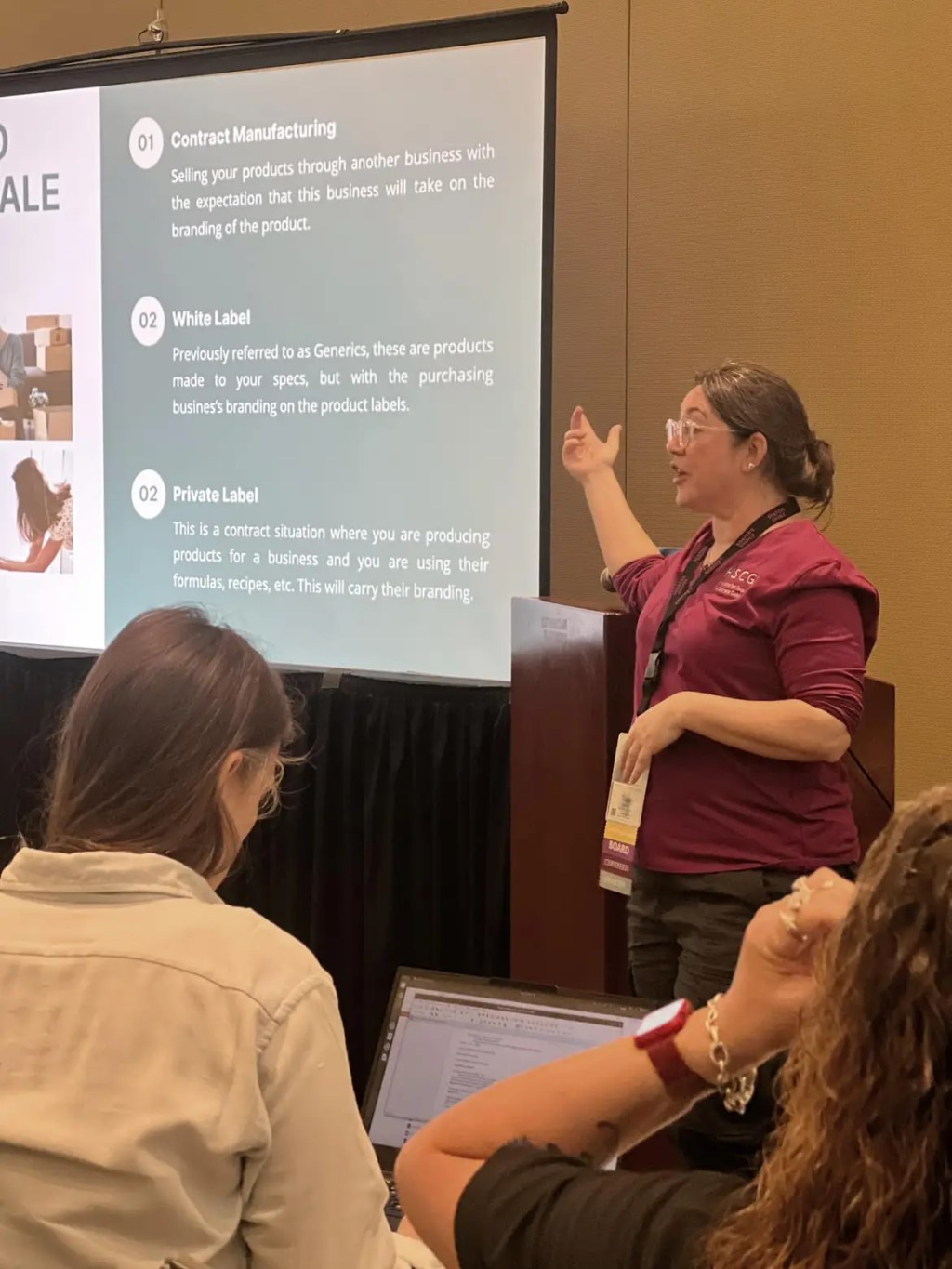
When and Why each one can work to your advantage
When you first start out selling your products, a significant amount of time is devoted to understanding and determining your cost of goods. From there, you work out your selling price, and things are good. Sales are starting to come in, and someone might approach you about selling in their shop. Your first potential wholesale account- how exciting! For many makers, this is the first time that their business feels- REAL.
Unfortunately, all of that excitement can come to a screeching halt, because now the shop owner is asking about wholesale pricing. Wait what? Why would I give anyone a huge discount on the items that I worked so hard to create? How will I ever make any actual money that way?
It’s true. Wholesale accounts expect significant decrease from your normal selling
price. Let’s start by identifying what each of these price points are, and why they are expected.
Cost of Goods. Cost of Goods (COGs) are what you are paying for your raw materials costs, labor/ payroll to make the items, and any additional overhead that needs to be factored in.
Retail Pricing. Your retail price should be a minimum of three times your COGs. The difference between your COGs and your Retail price pays for things like the time you take to sell your items (4 hours at the Farmer’s Market every Saturday morning?), profit, investment into future purchases and equipment upgrades, etc.
Wholesale Pricing. Generally, wholesale is double your COGs, or 50% off of your retail price. This allows for your wholesale account to mark up your product at least 50% for their own sales. They have to make some money too, right?
Retail is the best option when you are just starting out, and/or have not started scaling your products. It is also a great way to add on lower margin items like seasonal scents, or products that are more time consuming to make. These could be more decorative in nature, or fit into single cavity molds, etc.
Wholesale, on the other hand, works best for products that you can make quickly, in higher volume, and have a higher margin.
As an example, I offer my top selling soap for wholesale because it is a basic, one color design, and I can buy this particular scent in a very large capacity. Because this is a popular scent, I make much large batches at once, which drives my costs down significantly.
When you wholesale your products, you should be doing so with a high volume per product. Potential wholesale clients should not be buying products one or two pieces at a time. One of the trade offs for having a significant price reduction is that they buy in bulk from you. That might be 50 bars, or 100 bars, whatever makes the most sense for your business. The other advantage of selling in larger volume is that you are not taking the time to sell off those items individually.
If a wholesale customer buys 100 bars at $3 a bar, you have made $300 without
spending that much more time that what you normally would have to produce those bars.
Now consider how long it would take to sell those bars of soap at a weekly farmer’s market. If you spend 5 hours each week to sell 50 bars, it would take you 10 additional hours to sell that soap. Are you paying yourself? Nod your head yes, and make sure you have a nice hourly wage. Let’s say that’s $20 per hour. $20 X 10 Hours = $200 in additional payroll costs to sell those 100 bars of soap, not to mention booth fees, gas to and from, etc…
When you are selling wholesale, you don’t have that $200 cost. You are not the one spending the additional time and overhead to sell those soaps, your wholesale client is. By making sure you are reducing these kinds of additional costs, you can actually be much more profitable, while devoting less time to selling your products.
Successful wholesale relies on reducing all of your production costs to their most minute levels, while encouraging your wholesale clients to make larger, and less time consuming (for you) purchases.
If you think you are ready for Wholesale, ask yourself the following questions:
Are you able to buy your raw materials in a large enough quantity that you are
getting the best price per ounce, to allow for the reduction in your selling price? If
you buying waxes and oils one or two pounds at a time instead of (at least) a 35 LB bucket, you are not ready for a wholesale account for that item.
Are you able to make larger batches at once to reduce the time spent in
production? Instead of making a particular item one batch at a time, can you make five batches, or even twenty batches at once, for roughly the same amount of time? Are you outsourcing additional items to save time and resources? At some point, it will actually be cheaper to buy pre-made labels, or packaging supplies, than to have to format, print and cut them out yourself, based on this increase in sales volume. Additionally, you can outsource handcrafted products from makers like Sunny Girl Sundries, so you don’t have to spend all of your time and energy in production mode.
Did you require a large enough order from your wholesale account that it is worth
your time and effort? This is so important. A wholesale order is not just a large order. This is an order that should be significant in quantity, and also in frequency of ordering. It is encouraged that you set for minimum order requirements, as well as ordering frequency. Additionally, make sure that they are authorized to resell your items, and this is not an order for someone who just wants your items for cheap.
Wholesale accounts are an exciting and potentially very profitable step for your
business. With a little bit of effort devoted into proper pricing, scaling, and productivity, wholesale can be just as meaningful to your financial success as selling at a full retail price is.
Ready to take your business to the next level, but not sure where to start? Check out our Services or book a free Discovery Call with Founder Sara Golding to connect with an expert to help you turn your Passions into Profit.
 Sunny Girl
Leave a comment